
When Artificial Intelligence Was Invented
When artificial intelligence was invented, it started a brand-new chapter in technology. From early experiments to the modern AI boom, the journey has been filled with both innovation and challenges. The dream of making machines that could think like humans inspired scientists to explore machine learning and advanced algorithms. Early work laid the foundation for automation that now powers industries, healthcare, and everyday life.
While the idea has roots in ancient history, AI truly became a scientific field in the mid-20th century. Learning about its beginnings shows us how far AI has come and where it may go next.

What is Artificial Intelligence and Why It Matters
Artificial intelligence means computer systems built to do tasks that usually need human intelligence. These systems can learn, solve problems, and even make some decisions without human help.
Some AI focuses on one job, called narrow AI, while others aim for artificial general intelligence (AGI) — machines that can think like humans in every way. From natural language processing to autonomous systems, AI has become part of everyday life in the USA, changing industries and the way people work.
The Origins of Artificial Intelligence Before It Was Invented
The dream of intelligent machines is older than modern computers. In ancient Greece, myths spoke of automated handmaids built by the god Hephaestus. Centuries later, Leonardo da Vinci designed a mechanical knight that could move its arms and sit up.
In the 19th century, thinkers like Ramon Llull, Gottfried Leibniz, and Leonardo Torres Quevedo explored early automation and computer concepts. Their visions inspired real inventions, laying the path for modern AI.
Major Milestones Since Artificial Intelligence Was Invented
AI’s progress can be traced through key breakthroughs that shaped its future:
| Year | Event | Key People |
|---|---|---|
| 1950 | Turing Test introduced | Alan Turing |
| 1951 | First machine learning game program | Arthur Samuel |
| 1956 | Dartmouth Conference – AI officially named | John McCarthy |
| 1966 | ELIZA chatbot built | Joseph Weizenbaum |
| 1972 | STUDENT AI program created | Daniel Bobrow |
The AI Winters After Artificial Intelligence Was Invented
In the early days, expert systems like the XCON expert system showed potential but were costly to build and maintain. In the 1980s, Japan launched the Fifth Generation Project to advance natural language processing and autonomous systems. However, it didn’t meet its goals.
These slowdowns, called AI winters, brought less funding and slower research. They taught experts that creating artificial general intelligence would take far longer than expected
Artificial Intelligence After the Big Data Revolution
The 2000s brought big data, changing AI forever. Computers could now store and process massive amounts of information, leading to breakthroughs in deep learning. Neural networks began recognizing faces, translating languages, and powering self-driving cars.
Pioneers like Edward Feigenbaum and Alexey Ivakhnenko helped push modern AI beyond anything early systems could achieve.
Large Language Models and the Modern Artificial Intelligence Boom
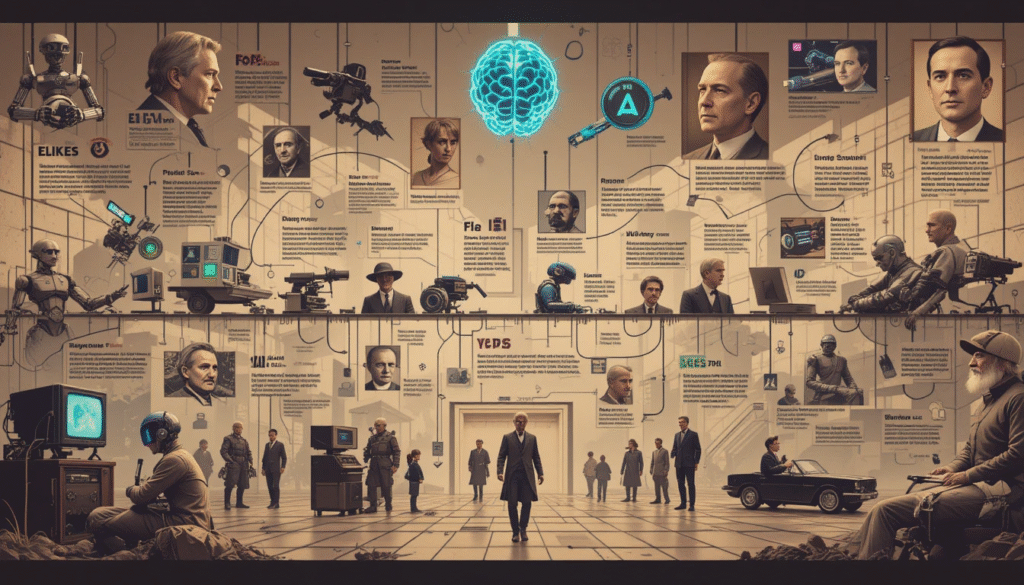
From 2017 onwards, large language models such as GPT transformed how AI understands and generates text. These systems could write essays, answer questions, and even create art.
The AI boom in the USA was driven by fast processors, big datasets, and advanced algorithms. Experts like Hans Moravec had predicted such tools decades ago — and now they’re here.
Key Applications of Artificial Intelligence in the USA Today
Today, AI plays a role in many industries:
- Healthcare: Helps doctors diagnose diseases and read scans.
- Transportation: Self-driving cars use autonomous systems for safety.
- Manufacturing: Industrial robots handle assembly lines.
- Customer Service: Chatbots and virtual assistants answer questions.
- Creative Work: AI creates music, designs, and stories.
Ethical Issues After Artificial Intelligence Was Invented
The rise of AI has sparked serious ethical debates. Automation can replace human jobs, leading to unemployment risks. AI may also carry bias in its algorithms, creating unfair results.
With more data collection, privacy concerns are growing. Experts like Joseph Weizenbaum warned years ago about trusting machines too much — advice still relevant today.
The Future of Artificial Intelligence in the USA
In the future, we may see true artificial general intelligence, capable of creative thinking and problem-solving like humans. Autonomous vehicles could become standard, and AI might help solve big challenges like climate change or disease.
Still, careful regulation will be vital. Researchers, companies, and governments must ensure AI stays safe, fair, and beneficial for everyone.
Artificial Intelligence in Popular Culture
Before AI was real, it existed in stories. The play Rossum’s Universal Robots gave us the word “robot.” Early films like Metropolis (1927) imagined humanoid machines, while novels like Erewhon explored mechanical intelligence.
In the 20th century, movies like 2001: A Space Odyssey introduced HAL, and Star Wars gave us C-3PO — both inspired by early robotics ideas.
FAQs About When Artificial Intelligence Was Invented
When was AI first used?
The term artificial intelligence was first used in 1956 during the Dartmouth Conference, led by John McCarthy.
Who is the founder of AI?
John McCarthy is called the father of AI for naming the field and advancing its research.
Who owns AI?
No one owns AI; it’s developed by researchers, companies, and governments worldwide.
Which country invented AI?
The concept began in the USA, though its roots go back to ancient automation ideas.
Meta Description:
Discover when artificial intelligence was invented, its origins, key pioneers, and the breakthroughs that shaped AI history for the USA audience.